What if the Earth were a disc?
A crazy question while cooking. A thought experiment about gravity, evolution and a world that could look completely different.
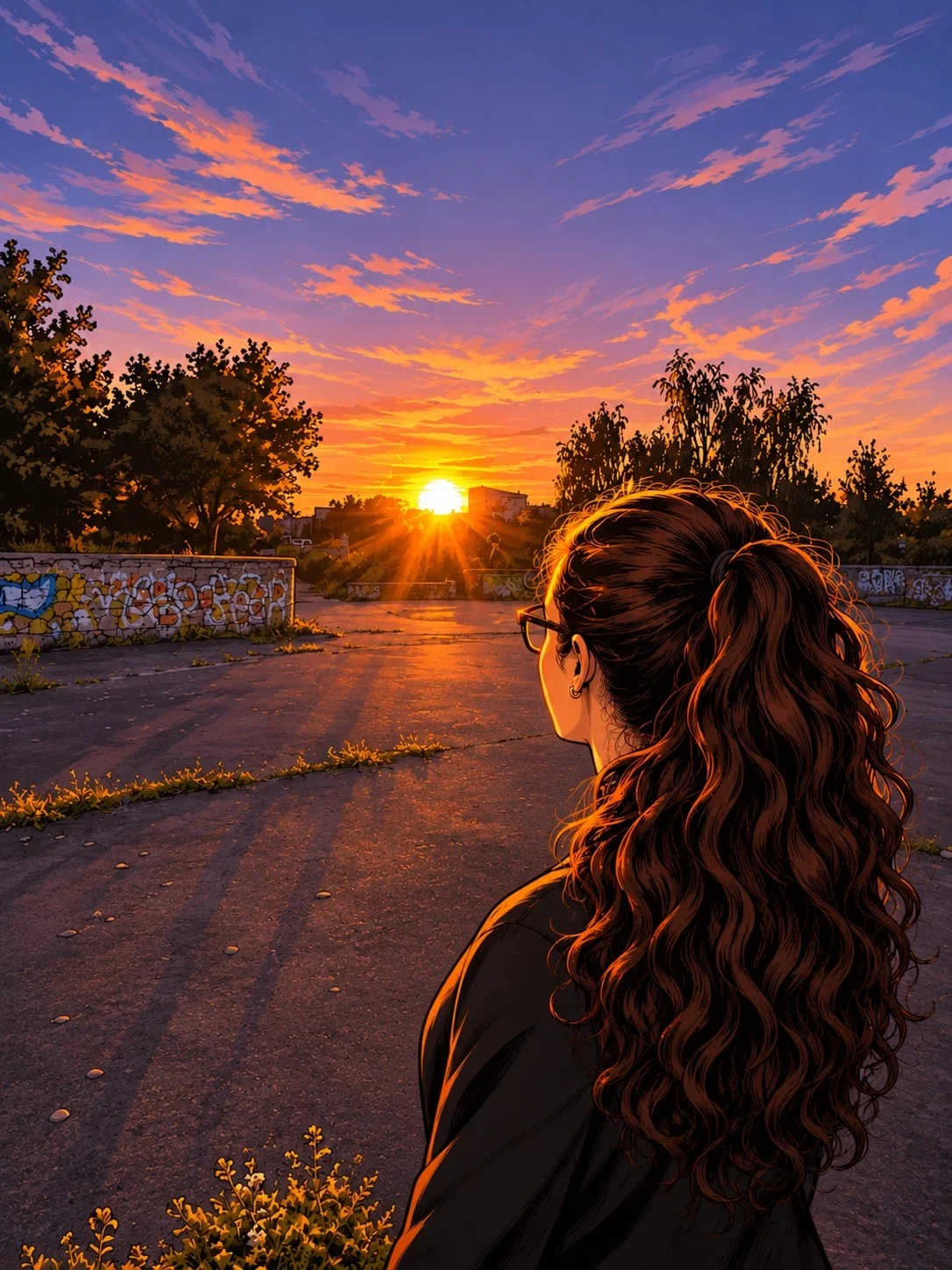
Sometimes my most interesting trains of thought begin in the most unspectacular moments. While cooking, for example.
One question had been on my mind for quite a while: what if the Earth actually were a disc?
Not because I doubt that our planet is roughly spherical. But because I wanted to know what consequences such a change would have.
Would gravity still work the same way? What would happen to our oceans? Could people live everywhere on this Earth? And if so, would we even look the way we do today?
Within a very short time, an initially rather absurd question turned into a small research project.
I grabbed ChatGPT and started playing through different scenarios. We discussed gravity, atmospheric pressure, the distribution of water and the question of how living beings might develop under completely different environmental conditions.
Of course it did not stop at theoretical considerations.
I made my own sketches, drew my ideas of the gravitational forces and tried to understand how the physical relationships would change on a disc-shaped Earth.
I found one idea especially fascinating: that on such a world gravity would not have to act perpendicular to the surface everywhere. The further you move away from the centre, the more strongly the pull could point towards the middle of the disc.
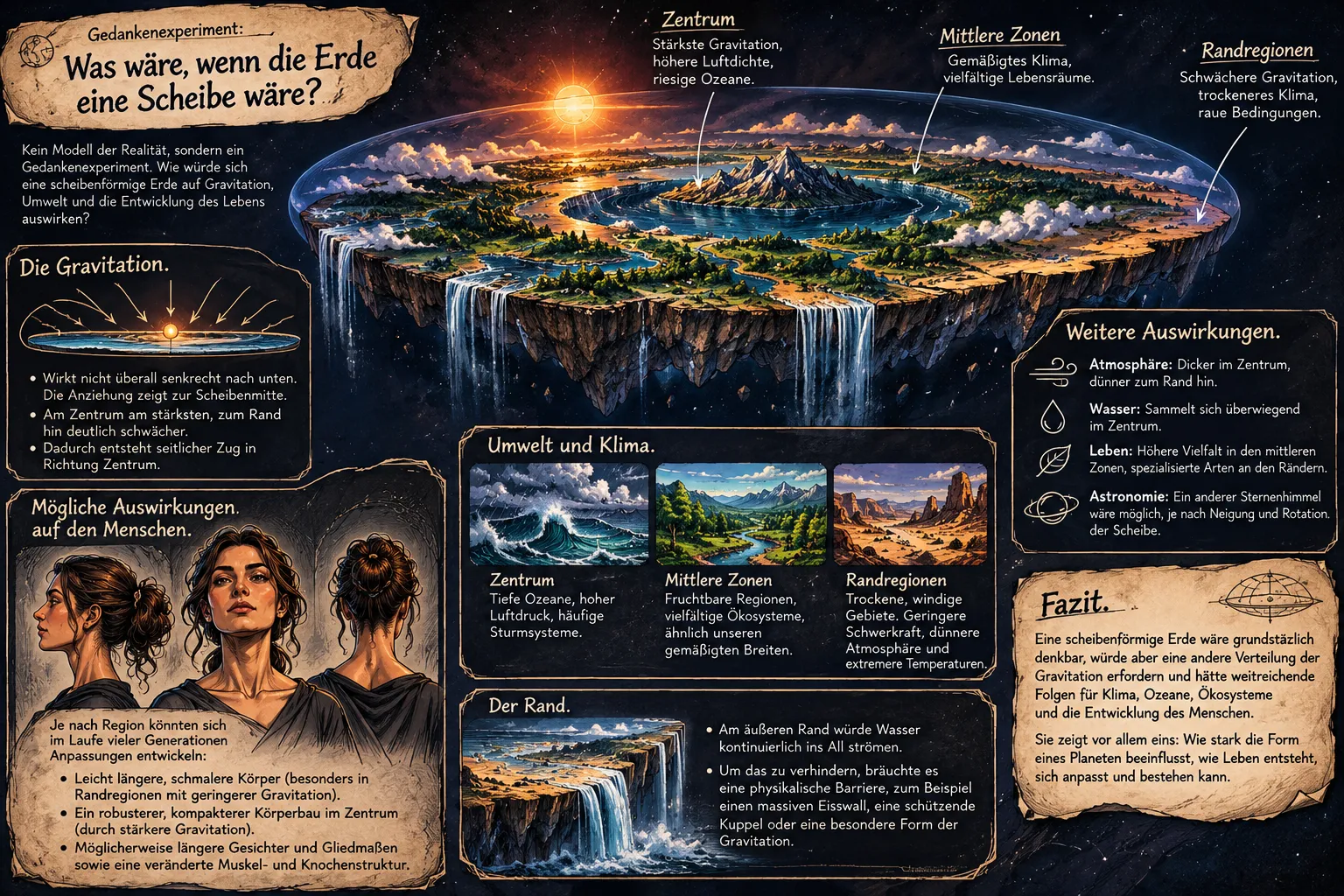
Suddenly completely new questions arose.
Would the oceans gather more strongly in the centre? Could the outer regions become drier? How would the atmosphere be distributed? And what effects would these conditions have on evolution?
Maybe people in some regions would have developed quite differently. Maybe their bodies would be adapted to unusual strains. Or maybe large parts of this world would not be habitable at all.
Of course all of this is a thought experiment. The answers depend heavily on which physical properties we give our fictional Earth. After all, a disc with the same mass as the Earth would behave quite differently from a thin disc with evenly distributed mass.
But that was exactly my point.
I did not want to prove that something improbable is true. I wanted to understand why our world works the way it does.
What began as a spontaneous question while cooking developed into a discussion about physics, biology and the limits of our imagination.
And that is probably the part I enjoy most: asking a single question and suddenly realising that a whole world of further questions is hiding behind it.
Sometimes you have to turn the world upside down in your mind to understand it a little better.